Center for Packaging and Unit Load Design
The Pallet Lab
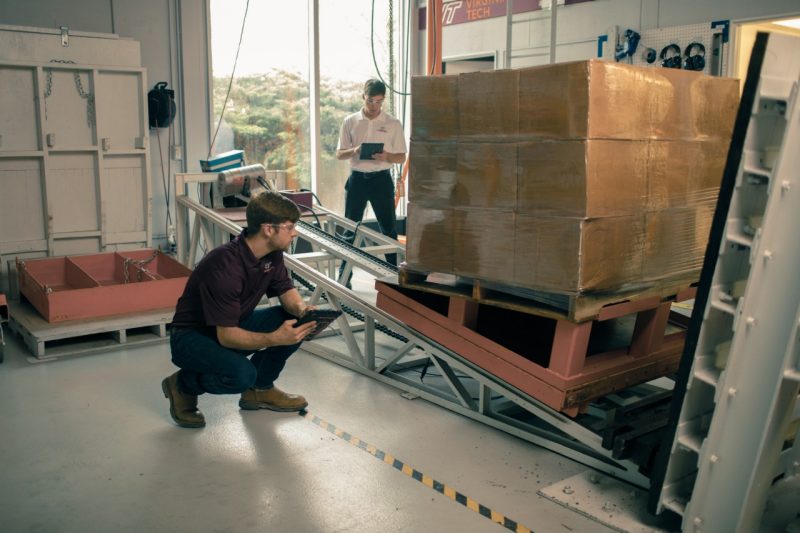
Our vision is to be the hub of packaging innovation
where researchers, students, and industry professionals
work together to improve the efficiency of the supply chain.
Our vision is to be the hub of packaging innovation
where researchers, students, and industry professionals
work together to improve the efficiency of the supply chain.
What customers say about CPULD:
"The VA Team was pleasant to interact with, efficient, and patient. We have begun sending more products to test since our initial experience as we receive outstanding service!"
“The price of testing was fair and communication was great throughout the whole process.”
"The collaboration with CPULD was excellant. It was a great experience!"
“I am very impressed by the service we receive from CPULD. It’s timely and very professional.”
Current CPULD News:
-
Article Item
 CPULD was featured in VT News' daily email! , article
Dr. Horvath and CPULD were featured in VT News' daily email!
-
Article Item
 Understanding Forklift Vibration for Pre-Shipment Testing: Insights and Recommendations , article
In the complex world of distribution, ensuring the safe delivery of products depends heavily on the ability of packaging systems to withstand the physical stresses encountered during transportation. One critical factor that affects product integrity is vibration. Whether products are being moved via trucks, railcars, or forklifts, the vibrations during transport can pose significant risks to packaged goods. Understanding the vibration environment during distribution is therefore essential to designing packaging systems that can protect products from damage. This article delves into the findings of CPULD’s graduate student, Yu Yang Huang’s study aimed at measuring and analyzing vibration levels during forklift handling and its implications for pre-shipment testing. The purpose of Huang’s study was to analyze the average vibration levels generated by forklifts and to provide insights that can be used for pre-shipment testing of packaging systems. By accurately simulating the vibration environment that occurs during forklift handling, packaging engineers can better assess the durability and suitability of their packaging systems.
-
Article Item
 Investigating the Impact of Pallet Design on Plastic Pail Performance , article
Palletized unit loads are fundamental to the supply chain. These distribution systems, composed of pallets, packaging, and unit load stabilizers, play a critical role in ensuring the safety and efficiency of logistics operations. While significant research has been conducted on corrugated boxes used in palletized loads, the behavior of plastic pails under similar conditions has remained largely unexplored. Plastic pails, widely used for transporting various liquid and solid materials, introduce unique challenges due to their structural characteristics and load distribution behavior. CPULD’s graduate student, Mary Paz Alvarez, conducted research focused on the interactions between plastic pails and pallet components, particularly the effects of pallet top deckboard thickness and pail location, with the aim of improving pallet design for safer and more sustainable transport of pails.
Page 1 of 8 | 24 Results
Student Spotlight:
Erin

Jacob Hall, Master's Student
Pallets are ubiquitous in the supply chain with over 2.6 billion in circulation in the United States alone. Although often overlooked, pallets can become costly for a company if not designed correctly for their specific supply chain.
More and more supply chains are using automated equipment to handle pallets and packages. Due to the large variability in sizes of pallets, this automation equipment often has difficulty. The objective of this research is to investigate what sort of automation equipment is used by supply chains and how pallets need to be designed in order to work with the most varieties of equipment.
Member Spotlight:
CHEP Logo

CHEP is a global provider of supply chain solutions serving the consumer goods, fresh food, beverage, manufacturing and retail sectors in more than 60 countries. CHEP offers a wide range of logistics and operational platforms and support services that are designed to increase performance and lower risk while improving environmental sustainability.
Center Members:
CHEP

Woodpack Global (formerly NWPCA)
Monoflo

Pallet Alliance logo

White and Co

Neopal

Orbis Corporation logo

RM2 logo